
Top 10 Water Jet Sewer Machine Companies for Effective Drain Cleaning
2026-11-16
Drain cleaning has come a long way from the days of blindly feeding a cable down a pipe. Water jetting is now the standard for actually clearing the line instead of just poking a hole through it. But if you've ever shopped for a sewer jetter, you know the market is flooded with options that look great on paper and struggle on the job. That’s why we put together this list of the top 10 water jet sewer machine companies for effective drain cleaning—no fluff, just the brands contractors and municipalities rely on when downtime isn’t an option. One name that consistently earns a spot in real-world conversations is AMJET, and we’ll show you how they stack up against the rest.
What Actually Happens When a Water Jet Meets a Clog
A high-pressure stream doesn't just hit the blockage and stop. The water slams into the clog's surface, then rebounds and curls backward, filling every void around the obstruction. That sudden reversal converts the jet's forward momentum into a sharp pressure spike that can travel upstream through the pipe, rattling joints and stressing weak points long before the clog itself moves.
Right at the contact face, the water's velocity drops so abruptly that microscopic vapor bubbles form and collapse almost instantly. This cavitation effect unleashes a barrage of tiny shock waves that gnaw at the clog's material, crumbling brittle deposits and loosening softer buildup. Even when the jet looks like a steady column from outside, the interface zone is anything but calm.
What happens next depends heavily on the clog's composition and the jet's delivery. Fibrous masses and congealed grease often compact into a denser plug under repeated strikes, making them harder to dislodge. Mineral scale and hardened debris, by contrast, tend to fracture and wash away in chunks. Less obvious is the secondary flow around the clog, which can erode the pipe wall if the blockage redirects the stream against the same spot for too long.
The Engineering Choices Behind Durable Sewer Jetting Units
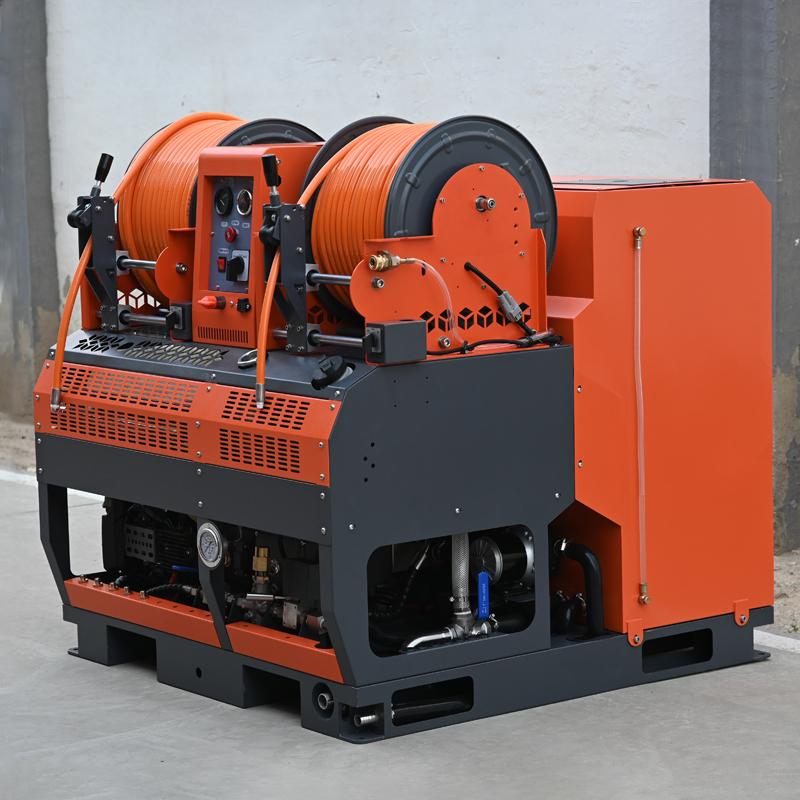
Durability in sewer jetting units starts with material choices that rarely make the spec sheet. Pump casings machined from duplex stainless steel rather than standard 316 resist the chloride-rich wastewater that eats through cheaper alloys within a season. High-pressure seals are often paired with ceramic plungers not for marketing reasons, but because the combination tolerates micro-abrasion from suspended grit that would score chrome-plated alternatives. Hoses reinforced with multiple layers of steel wire braid and covered in an abrasion-resistant polyurethane shell survive repeated dragging through manhole rims and lateral connections.
But material upgrades alone don't create longevity. The layout matters just as much. Vibration isolation mounts between the engine, pump, and frame prevent stress fractures that begin as hairline cracks around bolt holes. Heat management is another quiet decision: oversized oil coolers and air-to-water intercoolers keep hydraulic fluid well below its degradation threshold, which extends seal and hose life more than any additive. Quick-connect fittings are placed in accessible locations, so technicians can replace O-rings and seals without disassembling the reel or valve manifold. These choices aren't visible in a brochure; they show up a decade later, when the unit still holds pressure after thousands of hours of municipal service.
A Closer Look at Brands Contractors Keep Recommending
Ask a contractor which brand they trust and you rarely get an answer pulled from a spec sheet. Talk long enough on a job site and the same names keep coming up, not because of slick ads but because those tools have survived drops, dust, and daily abuse. It usually comes down to little things: batteries that swap across a whole kit, repair centers within driving distance, and a trigger that still feels right after eight hours. Those are the reasons a recommendation gets passed from one crew to the next.
Milwaukee and DeWalt get mentioned constantly, partly because their cordless platforms are deep enough to cover almost every task without switching chargers. A plumber might point to a specific impact driver that has taken a fall off a ladder more than once and still runs true. Makita has its loyal following too, especially among finish carpenters who care about tool weight and balance. And then there are higher-end names like Festool that get brought up in the same breath as dust extraction and precision, though most contractors will tell you that's a serious investment, not a casual recommendation for a first-time buyer.
What really drives repeat recommendations is cost over time, not the sticker price. A contractor does quick math on downtime: if a cheap tool dies mid-job and the nearest service center is three states away, the “savings” disappear fast. That's why the brands that earn steady word of mouth tend to have boring but dependable supply chains, local parts availability, and a track record of not changing battery formats every couple of years. As one electrician put it, “I'm not buying a drill. I'm buying the next five years of not thinking about it.”
Matching Nozzle Pressure to the Worst Blockages
The worst blockage in a line dictates the pressure you need at the nozzle, not the other way around. If you set pressure based on average debris, sections with compacted scale or hardened grease will stay intact, and you’ll waste time re-cleaning the same stretch. Start by identifying the most resistant deposit—often where flow has been restricted the longest or where mineral buildup has fused with pipe walls.
Once you know what that worst section looks like, work backward to account for pressure losses along the hose length, bends, and nozzle restrictions. A common mistake is reading pump discharge pressure and assuming it reaches the nozzle unchanged. In long runs or tight bends, you might lose several hundred psi before the water exits the tip. Set the pump high enough so that the nozzle still delivers enough impact force to break the toughest blockage, but not so high that you risk blowing joints or eroding softer pipe material.
A practical approach is to begin slightly below your estimated threshold and bump pressure upward in small increments while monitoring how the nozzle reacts and what debris comes back. When the return flow shifts from cloudy water with small chunks to larger, broken pieces of the hardest deposit, you’ve matched the pressure to the worst blockage. This also keeps you from running at maximum pressure all day, which wastes fuel and wears seals prematurely.
How Municipal Fleets Evaluate a Water Jetter Before Buying
Most municipal fleet managers don't rely solely on spec sheets when sizing up a water jetter. They'll ask the vendor to bring the unit to an actual clogged line or a mock-up that mirrors the city's typical pipe diameters and bend configurations. Watching the nozzle push through a 90-degree elbow under full pressure tells them more than any brochure number. They also pay close attention to how the hose feeds—whether it binds or kinks when the operator pauses, and whether the pressure relief kicks in smoothly instead of abruptly cutting flow. That on-the-ground feel often separates a machine that works on paper from one that holds up on a Tuesday morning after a storm.
Maintenance access is another quiet dealbreaker. City crews run these units hard, and the same machine might get used by three different shifts in a week. Fleet supervisors will open the side panels and check how easy it is to reach the inline filter, the unloader valve, and the pump's oil fill. They'll ask the dealer for a realistic time estimate to swap a high-pressure hose reel or replace a packed gland, not the ideal-shop number. Some managers go further and request contact info for a neighboring municipality that has run the same model for two winters—then call to ask about seal failures, nozzle wear, and how long parts sat on backorder.
Total cost rarely comes down to the sticker price. A sharp evaluator works up a five-year operating figure that includes fuel burn at idle during long cleanouts, the replacement interval for nozzles and hoses, and whether the pump needs a glycol flush before every freeze. They also probe the vendor's training policy: a city with high operator turnover needs unlimited refresher sessions, not one launch-day walkthrough. If the supplier hesitates on that point, the jetter often gets crossed off the list—even when the pressure and flow numbers look strong on the comparison chart.
Little-Known Maintenance Steps That Prevent Costly Downtime
Most maintenance schedules focus on the big-ticket items—lubricating bearings, checking fluid levels, replacing filters. But the real downtime culprits often hide in the margins. One overlooked step is torque verification on electrical connections. Vibration and thermal cycling can loosen terminal screws over time, leading to intermittent faults that mimic sensor failures. A quick pass with a calibrated torque screwdriver on control panels and motor junction boxes takes minutes but prevents hours of chasing ghost errors.
Another quietly powerful habit is logging baseline current draws for every motor and pump. Without a reference, a gradual increase in amperage goes unnoticed until the overload trips. By recording a five-second inrush and steady-state reading at commissioning, then comparing quarterly, maintenance teams catch bearing wear, impeller clogging, or voltage imbalance weeks before failure. The logbook itself becomes a diagnostic tool, not just paperwork.
Finally, consider thermal imaging of cable trays and busbars during normal operation—not just after a fault. Hot spots at splice points, loose bus joints, or overloaded neutrals show up clearly when the system is under typical load. Fixing a discolored lug during a planned window costs a fraction of an emergency shutdown. These steps require no exotic equipment, just a shift from reactive checking to pattern recognition.
FAQ
Effectiveness comes from the right combination of pressure, flow rate, and nozzle design. A machine with adjustable pressure and a selection of nozzles can break through grease, roots, and scale without damaging pipes.
Several names stand out, including RIDGID, Spartan Tool, General Pipe Cleaners, US Jetting, Duracable, and Electric Eel. These manufacturers offer a range of trailer-mounted and cart-mounted units with solid pump and engine options.
Electric models are quieter, lighter, and better for indoor or residential use where ventilation is limited. Gas-powered machines provide more power and greater mobility for larger municipal or commercial jobs without relying on an outlet.
For most residential lines, 1500 to 4000 PSI with a flow rate of 2 to 5 gallons per minute works well. Higher pressure is rarely needed and can risk damaging older or weaker piping.
Always wear eye protection, gloves, and non-slip boots. Inspect hoses and fittings before each use, never point the nozzle at anyone, and use a foot pedal or trigger gun to control water flow safely.
Basic maintenance includes checking oil levels, cleaning inlet filters, flushing the system after each use, and inspecting nozzles for wear. More thorough servicing of the pump and engine should be done every 100 to 200 hours of operation.
It can if the pressure is too high or the nozzle is held in one spot too long. Older clay, cast iron, or Orangeburg pipes need lower pressure and a gentle nozzle to avoid cracks or joint damage.
Prices vary widely based on power and features. A compact cart-mounted unit may start around $3,000 to $6,000, while a trailer-mounted machine with high flow and pressure can run from $15,000 to over $50,000.
Conclusion
When a high-pressure water jet meets a clog, it doesn't simply push the blockage aside. The stream's kinetic energy fragments grease, sludge, roots, and mineral scale into small pieces that flush downstream, often restoring full pipe diameter in minutes. Durable sewer jetting units earn their reputation through engineering choices that field crews notice immediately: triplex ceramic plunger pumps that tolerate grit, stainless steel hose reels that resist corrosion, and nozzles made from hardened steel rather than cheap alloys. The brands contractors keep recommending aren't always the most advertised; they're the ones with accessible parts, straightforward pressure adjustment, and frames that survive years of bouncing around in truck beds.
Nozzle pressure has to be matched to the worst blockage, not the average one. Grease and soap scale clear at 1,500–2,500 PSI with enough flow, but tree roots and hardened scale demand 4,000 PSI or more, and flow rate often matters more than raw pressure for moving debris out of long runs. Municipal fleets evaluate a water jetter before buying by looking past the brochure: they test hose reel ergonomics, check pump duty cycle at full pressure, and ask about the cost and lead time for seals and valves. Little-known maintenance steps also separate reliable machines from garage queens—flushing the pump with clean water after every job, swapping O-rings before they crack, checking nozzle orifices for wear with a pin gauge, and using RV antifreeze during winter storage. The top ten companies earn their place by paying attention to these unglamorous details that keep drain cleaning crews productive instead of waiting on a parts truck.
Contact Us
Contact Person: Mike
Email: [email protected]
Tel/WhatsApp: +86 19545555505
Website: https://www.amjeting.com/