

Stainless Steel Hex Bolts Solutions for Strong and Corrosion-Resistant Connections
2026-10-07
When a bridge joint fails or a marine railing loosens, the culprit is rarely the design—it's usually the bolt. Standard fasteners quietly surrender to rust and fatigue, compromising what should be a permanent connection. That's why we're turning to stainless steel hex bolts, the unsung heroes of corrosive environments. At Wanluo, we've focused on refining these workhorses to deliver exceptional tensile strength without the maintenance headache. In this post, we’ll break down what makes them different, where they shine, and how to choose the right grade for your next build.
The Real Reason Stainless Hex Bolts Survive Where Zinc-Plated Bolts Fail
Zinc-plated bolts don't fail because the zinc is weak; they fail because the zinc is meant to be consumed. The coating acts as a sacrificial anode, slowly corroding so the steel underneath stays intact. But once that layer is breached or worn thin, there's nothing left to stop the carbon steel from rusting, and threaded connections seize or snap.
Stainless hex bolts take a fundamentally different approach. The chromium in the alloy reacts with oxygen to form an invisible, self-healing oxide film on the surface. If the bolt gets scratched or machined, that film re-forms almost immediately, as long as oxygen is present. There's no separate coating to wear away, so the protection isn't a finite resource.
That's why stainless hex bolts keep working in rain, salt spray, and humid industrial settings long after zinc plating has given up. They aren't invincible—crevices or oxygen-starved conditions can still cause pitting—but for most outdoor and marine fastening, the difference comes down to a passive layer that repairs itself rather than a sacrificial coating that eventually runs out.
Matching Hex Bolt Alloy to the Job: When 316 Outperforms 304
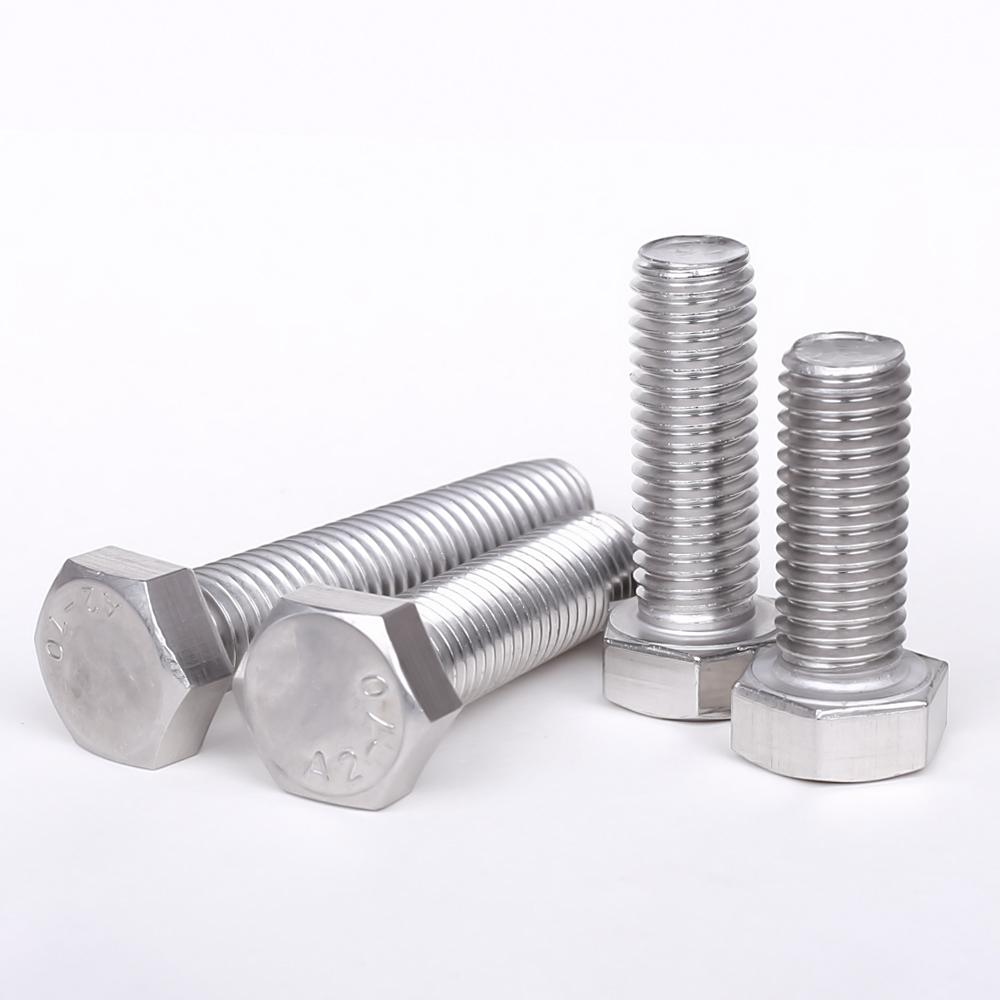
Most stainless hex bolts start with 304 because it handles basic moisture and mild corrosive settings at a lower price. But if the job involves salt, chlorides, or aggressive chemicals, 316-grade alloy pulls ahead quickly. The difference comes down to molybdenum: 316 contains 2–3 percent of it, which forms a tougher passive layer and resists pitting that 304 simply cannot stand up to over time.
Think of a marina cleat bolted to a pier or an outdoor electrical enclosure near a coastal road. Salt spray constantly attacks the surface, and 304 fasteners will show rust staining within months. Swap to 316 hex bolts, and the same fixture can last years without surface breakdown. The same holds for chemical plants, pulp mills, and food processing lines where chlorinated cleaners or acidic byproducts eat away at standard stainless.
Cost often drives the initial choice toward 304, but premature replacement and downtime erase that savings. When a bolted joint sits in a chloride-rich environment, 316 is not a luxury—it is the correct alloy for the job. Checking the actual exposure conditions before ordering prevents the most common field failure: using the cheaper grade where it cannot survive.
Stop Thread Galling Before It Ruins Your Stainless Fastener Assembly
You can feel it the moment a stainless nut starts to bind—just a little extra resistance that quickly turns into a complete lockup. That's galling, and it happens because the protective oxide layer on stainless steel gets scraped away under pressure, allowing bare metal to friction-weld together.
Prevention starts before the first turn. Use a quality anti-seize or molybdenum disulfide lubricant rated for stainless, and consider mixing fastener grades or alloys so the nut and bolt don't share identical hardness. Reducing installation speed—especially with power tools—also keeps heat and friction below the galling threshold.
Clean threads are non-negotiable. Any embedded grit or metal shavings from manufacturing or previous assembly acts like sandpaper, breaking through the oxide film. Inspect every thread before assembly, and if a fastener ever starts to drag, stop immediately, back it off, and inspect rather than forcing it. That pause saves hours of drilling out a seized bolt later.
Getting Clamp Load Right Without Over-Torquing Stainless Bolts
Most people assume tighter is better when it comes to stainless bolts, but that habit quietly wrecks the very clamping force you're chasing. Stainless has a nasty tendency to gall, and once the threads start to seize, your torque wrench lies to you. A modest torque reading can hide enough friction to leave you with a joint that's only half as tight as you think.
Instead of leaning on torque alone, pay attention to the stretch. A properly loaded stainless bolt behaves like a stiff spring, and that elongation is what actually holds the joint together. Using a dial indicator or even a careful micrometer across the bolt length tells you more than any torque spec ever will. Clean threads, a dab of anti-seize only where the design calls for it, and slow wrenching make a bigger difference than cranking down harder.
And don't assume the factory torque chart knows your exact setup. Surface finish, thread class, and even whether you're reusing a bolt change the friction dramatically. The safe move is to run a quick test on a scrap piece: torque up in small steps while measuring stretch, then back off and see what torque actually gave you the right clamp load. That's the number you trust, not the generic number from a manual.
Designing Hex Bolt Joints That Stay Tight in High-Vibration Equipment
Achieving a reliable hex bolt joint under constant vibration starts with understanding how clamping force decays. Preload, not thread friction, is what keeps the assembly together. When components are bolted, the fastener must be stretched into its elastic range so that the resulting tension creates enough friction between mating surfaces to resist relative motion. If this preload drops below the external separating force, micro-slippage begins. From there, joint loosening accelerates until complete failure.
A common but costly mistake is relying solely on high torque values or thread-locking compounds to compensate for poor joint design. The shape and stiffness of the clamped parts matter more than many realize. Longer grip lengths, hardened washers, and flanged hex heads all help distribute stress and maintain a stable preload under dynamic loading. Surface roughness and flatness also influence how much embedding occurs after initial tightening. By selecting fasteners that remain within their elastic limit and matching them to the joint stiffness, engineers can prevent the slow self-loosening that vibration induces.
Using Stainless Hex Bolts in Washdown and Food Areas Without Extra Coatings
Stainless hex bolts hold up well in washdown environments because the passive chromium oxide layer resists rust without needing paint, zinc, or other surface treatments that can chip or peel. In food processing plants, this matters more than many realize: a flaking coating can end up in product, trigger a recall, or create a niche where bacteria survive routine cleaning.
Another advantage is the smooth, non-porous surface. Without an extra coating, there are fewer microscopic crevices for moisture and food residue to collect. That makes stainless hex bolts easier to sanitize with hot water, steam, or standard food-grade cleaners, and they won't degrade from repeated exposure to aggressive washdown chemicals the way coated fasteners often do.
For maintenance teams, choosing uncoated stainless hex bolts in these areas also reduces long-term replacement frequency. You skip the step of touching up scratched or worn coatings, and you avoid the hidden corrosion that starts under a damaged layer. It's a simpler, more reliable choice when the priority is keeping the line clean and the product safe.
FAQ
The obvious difference is the chromium content, which forms a self-healing oxide layer on the surface. That layer is what blocks rust and keeps the connection intact even when moisture or chemicals are present. Carbon steel simply can't match that without a coating, and coatings tend to chip or wear away over time.
Yes, but grade matters. 316 stainless is the go-to for saltwater because it includes molybdenum, which gives extra resistance to chlorides. 304 can work in milder outdoor conditions, but it may show surface staining near the coast. For anything submerged or constantly splashed, stick with 316 or a marine-grade alloy.
For most indoor and light outdoor structural tasks, 304 stainless offers a solid balance of strength and corrosion resistance. If the connection will face heavy moisture, de-icing salts, or chemical exposure, 316 is worth the additional cost. Avoid 18-8 if you're concerned about pitting in aggressive environments, even though it's often lumped together with 304.
The main thing is to avoid over-tightening with power tools. Stainless is softer than high-strength carbon steel, so it's easier to strip threads or round off the hex head. Using a torque wrench and applying steady, even pressure is the simplest way to prevent damage. Softer jaws or a six-point socket also help keep the head intact.
Galling happens when the oxide layer gets scraped off under pressure and the bare metal friction-welds itself together. The easiest prevention is a small amount of anti-seize or thread lubricant on the threads before assembly. Slowing down the installation speed also makes a big difference, because heat buildup is what triggers most galling incidents.
Yes, mixing stainless bolts with zinc-plated or plain steel hardware creates a galvanic couple that accelerates corrosion on the less noble metal. Stick with a matching stainless grade for nuts and washers, ideally from the same material family. If you need electrical isolation, nylon or fiber washers can break the contact without compromising the mechanical hold.
Typical 304 and 316 stainless bolts fall into the medium-strength range, usually around 70,000 psi tensile strength. They aren't meant to replace high-strength alloy bolts in critical tension applications, but for structural connections, brackets, and equipment mounting they provide more than enough holding power. Always check the specific grade and diameter against your load requirements before finalizing the design.
Maintenance is minimal. In most environments, occasional visual inspections are enough, especially around threads and under the bolt head where debris can collect. If you notice surface discoloration, a mild citric acid or specialized stainless cleaner will restore the passive layer. Avoid steel wool or wire brushes, as they can embed carbon steel particles and create rust spots.
Conclusion
Stainless steel hex bolts earn their reputation in demanding environments because their corrosion resistance is intrinsic, not a surface treatment that can chip or wear away. While zinc-plated fasteners rely on a thin sacrificial layer that eventually fails, stainless alloys form a self-healing passive oxide film. This is why in washdown areas, marine settings, or food processing plants, stainless hex bolts maintain both strength and hygiene without additional coatings. Yet choosing the right alloy matters: 304 works for general corrosion, but when chlorides, acids, or salt spray are present, 316’s molybdenum content prevents pitting that would quietly destroy a lesser grade. The key is matching the alloy to the actual exposure, not simply assuming all stainless is equal.
Beyond material selection, successful stainless hex bolt assemblies depend on controlling friction. Thread galling—a cold welding effect that seizes fasteners during installation—is a common failure many overlook. Slowing down installation speed, using a suitable anti-seize lubricant, and avoiding mismatched thread fits dramatically reduce galling risk. Equally important is achieving correct clamp load: because stainless has lower thermal conductivity and higher work-hardening than carbon steel, torque values must be adjusted. Over-torquing distorts threads and reduces joint integrity; under-torquing invites loosening under vibration. For high-vibration equipment, designers often add locking features such as nylon patches, serrated flanges, or secondary locking elements—without sacrificing stainless corrosion performance. A well-designed stainless hex bolt joint balances material grade, installation practice, and locking strategy, delivering connections that stay tight and corrosion-free for years.
Contact Us
Contact Person: Shane
Email: [email protected]
Tel/WhatsApp: 8613357785029
Website: https://www.wanluohardware.com