

China Polymer Insulator Guide for Reliable Electrical Insulation
2026-10-02
Polymer insulators are quietly transforming how we think about electrical insulation, especially in harsh conditions. This guide explores the key factors behind China's leading role in this technology, from silicone rubber housings to hydrophobic performance. For those seeking dependable products, Lugao stands out as a manufacturer worth knowing. Whether you're an engineer or a procurement specialist, understanding these insulators can save you from costly failures. Read on to uncover practical insights that go beyond the spec sheets.
From Factory Floor to Transmission Tower: Tracing a Polymer Insulator's Journey
The journey begins on a busy factory floor, where a fiberglass-reinforced epoxy resin rod—the load-bearing spine of the insulator—is cut to length and prepared for bonding. Liquid silicone rubber is then injection-molded around the rod to form the weathersheds and housing, a process that demands precise control of temperature, pressure, and cure time. Any microscopic void or incomplete adhesion between the rubber and the rod can become a starting point for electrical tracking or moisture ingress, so each unit passes through a battery of inline checks: dimensional scans, Shore hardness tests, and high-voltage dry flashover verification. Even the metal end fittings, typically forged aluminum or malleable iron, are crimped or pressed onto the rod under calibrated force, ensuring a mechanical connection that will hold under years of tensile load and ice shedding.
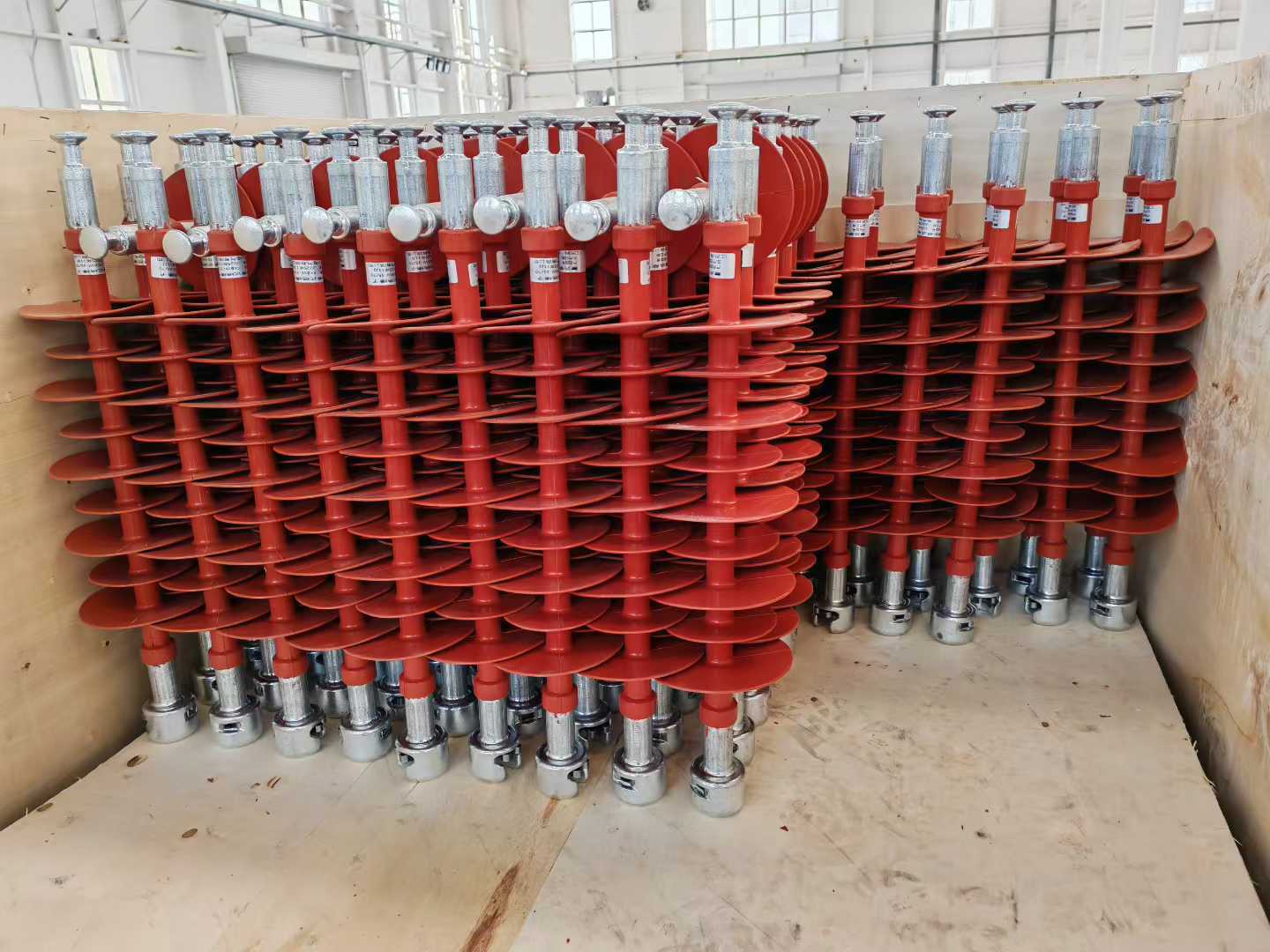
Once the insulators pass final inspection, they leave the factory in custom-fitted crates or on steel pallets, each one separated by foam dividers or inflatable air bags to prevent scuffing of the silicone surface. Batch numbers are laser-etched onto the fittings, linking every unit back to its raw material lots and production date. During transit, careful handling is non-negotiable: a sharp impact against a trailer wall or an uneven stack can create invisible micro-cracks in the housing, which may only reveal themselves after the first heavy rain or salt fog event. Some utilities specify dedicated transport routes or require a factory representative to supervise loading and unloading at the substation, because the cost of a single failed insulator pales in comparison to the outage it could trigger on a 345 kV line.
At the transmission tower, the polymer insulator is hoisted into position and attached to the crossarm or suspension clamp, often replacing a string of porcelain or glass discs. Once energized, it quietly takes on a dual role: mechanically supporting the conductor while continuously shedding leakage current across its hydrophobic silicone surface. Over the next few decades, it will face ultraviolet exposure, pollution buildup, corona discharge, and thermal cycling—yet unlike ceramic insulators, it does not shatter under vandalism or seismic shock. Field inspections rely on visual checks for chalking, erosion, or tracking marks, supplemented by infrared thermography to spot hot spots that signal internal defects. The insulator that started as a rod and a drum of liquid silicone now stands as a critical link between generation and consumption, its factory-floor origins hidden but never forgotten by those who understand that reliability on the grid is built one molding cycle at a time.
When Monsoons Meet High Voltage: Designing for Humidity and Pollution
In coastal and industrial zones, monsoon rains don't just bring water—they mix with airborne salts, soot, and chemical residues to create a conductive slurry that clings to insulators and busbars. The real threat isn't a single downpour but the repeated wetting and drying cycles that deposit contaminants in layers, lowering surface resistance until a flashover occurs at voltages well below the rated withstand.
Design must treat humidity and pollution as a coupled stress, not separate parameters. This means specifying longer creepage distances, using silicone rubber or other hydrophobic coatings that encourage water beading, and sealing control cabinets against both moisture ingress and corrosive gases. Small details matter: gaskets rated for continuous immersion, breather drains that don't clog with particulate, and terminal boxes oriented to shed water rather than collect it.
Field data from substations in Mumbai and Dhaka shows that unsealed auxiliary contacts and unprotected cable joints fail first—often within two monsoon seasons. The fix is rarely exotic; it's disciplined material selection and maintenance access that lets crews inspect and clean without shutting down the whole feeder. If the design assumes perfect cleanliness, it will fail when the first dust storm meets the first squall.
Beyond the Datasheet: What Chinese Manufacturers Won't Tell You About Aging
A datasheet will happily list a capacitor's rated lifespan at 105°C, but it rarely mentions what happens when that temperature fluctuates by twenty degrees every few hours. Chinese manufacturers often rely on accelerated aging tests that compress years of wear into weeks, yet these tests assume a smooth thermal profile. In real-world power supplies, the constant expansion and contraction of solder joints and dielectric materials accelerates degradation far beyond the lab numbers. The result: components that pass their initial specification but drift out of tolerance within eighteen months of field deployment.
Electrolytic capacitor formulations are a prime hiding spot. To hit aggressive price targets, some suppliers tweak the electrolyte's boiling point or reduce the thickness of the aluminum oxide layer. The datasheet still shows the same capacitance and ESR values, but the long-term evaporation rate of the electrolyte doubles. It is the kind of detail that never appears in a product brief because it would scare off procurement teams. Instead, buyers discover it when their LED drivers start flickering on hot summer afternoons, and the failure analysis report quietly points to "premature aging."
Independent long-term aging data is almost nonexistent for commodity parts coming out of Shenzhen or Dongguan. A reputable Western brand might publish reliability reports with Weibull curves and field return statistics. Chinese manufacturers, especially the smaller ones, treat that information as proprietary or simply do not collect it. So engineers are left to run their own accelerated life tests, which most small and mid-sized companies skip due to time and budget constraints. The gap between the datasheet's confident specifications and the messy reality of thermal cycling, humidity, and voltage transients is where unexpected failures breed.
The Role of Alumina Trihydrate in Keeping Polymer Insulators Fire-Safe
Polymer insulators face a constant risk of fire when exposed to high-voltage arcs or surface leakage currents. Alumina trihydrate, often abbreviated as ATH, is the workhorse additive that changes this picture. When the polymer matrix heats up, ATH begins to break down at around 200–220 °C, absorbing a large amount of heat in the process. This endothermic reaction pulls thermal energy away from the insulator surface, slowing the temperature rise and making it much harder for the material to reach the ignition point.
Beyond just cooling the surrounding polymer, the decomposition of ATH releases chemically bound water as vapor. That water vapor dilutes the flammable gases produced by the degrading polymer and reduces the oxygen concentration near the hot surface. At the same time, the reaction leaves behind a porous alumina layer. This ceramic-like residue acts as a physical barrier, limiting heat transfer into the bulk material and shielding the inner polymer from direct flame contact.
Practical formulations usually need 40–60% ATH by weight to achieve meaningful fire resistance, which inevitably affects mechanical strength and processing. Manufacturers work around this by adjusting particle size, surface treatments, and blending ATH with other flame retardants. The goal is not to make polymer insulators completely non-flammable, but to raise the threshold for sustained burning enough that a transient arc or spark does not turn into a structural fire.
Field Reports from Yunnan and Guangdong: Lessons in Coastal and Mountain Insulation
In the high-altitude valleys of northwestern Yunnan, insulation failures rarely show up as a single dramatic event. Instead, repeated freeze-thaw cycles work through microcracks opened by intense daytime UV exposure and sealed again by night frost. One field station near Shangri-La recorded a 12-degree Celsius swing between sun and shade on a single December afternoon, enough to fatigue standard EPS boards within three seasons. Local builders had long relied on rammed earth, which buffers temperature swings but offers little steady-state resistance. Combining a 60 mm layer of closed-cell foam glass behind a ventilated rain screen finally stabilized indoor temperatures without trapping moisture behind the earth wall.
Coastal Guangdong presents the opposite problem. Relative humidity above 85% for weeks, salt-laden air, and wind-driven rain during typhoon season punish any insulation that absorbs moisture. A retrofit in Zhanjiang initially used open-cell fiberglass batts with a polyethylene vapor barrier, but within two years the batts sagged and measured thermal resistance dropped by nearly half. Switching to a hydrophobic rock wool board with a permeable but water-shedding membrane, and adding a drained cavity behind the cladding, cut cooling energy use by a fifth. The key lesson was that vapor drive in a hot-humid climate moves from outside inward, so the barrier placement had to be inverted compared to northern practice.
Side by side, the two regions show that insulation is not a product spec but a response to local weather. Mountain sites demand toughness against thermal shock and mechanical stress, while coastal sites demand moisture resilience and salt tolerance. In both cases, the most impressive performance gains came from details—overlapping joints, sealed penetrations, drainage gaps—rather than from higher R-values on paper. Builders who treated insulation as part of the wall system, not an add-on, consistently outperformed those who simply followed catalog recommendations.
Decoding Test Reports: Key Parameters That Predict Long-Term Reliability
When you first open a test report, the sheer volume of charts and acronyms can feel overwhelming. But long-term reliability rarely hides in a single headline number. Instead, it emerges from how a handful of parameters behave together under stress. Look past the pass/fail stamp and focus on degradation trends: how much leakage current drifts after 1,000 hours at elevated temperature, whether insulation resistance dips below the spec line during the final humidity cycle, or how contact resistance shifts after repeated thermal shock. These small, incremental changes often reveal more about field life than any single threshold crossing.
One of the most telling indicators is the shape of the failure distribution in accelerated life testing. A tight cluster of failures early in the test usually points to a manufacturing defect or a weak component batch, whereas a slow, steady wear-out pattern suggests a fundamentally sound design that will degrade predictably. Equally important is the confidence interval around the reported MTBF or MTTF. A report that claims 50,000 hours but carries a 90% confidence interval from 12,000 to 90,000 hours is far less reassuring than one with 45,000 to 55,000 hours at the same confidence level. Broad intervals mean the test sample was too small or the environment too variable to trust.
Environmental stress parameters deserve special scrutiny, especially when the product will face temperature swings and humidity in real use. Look at the ramp rates in thermal cycling, not just the endpoint temperatures. A report that cycles between -40°C and 85°C at 2°C per minute is much harsher than one that jumps at 20°C per minute, because slower ramps allow solder joints and polymer seals to reach equilibrium and develop fatigue. Similarly, check for bias during damp heat testing. Humidity exposure with voltage applied can trigger electrochemical migration that a non-biased test would miss entirely. Small details like these separate a report written for compliance from one that actually predicts years of service.
FAQ
Salt fog and humidity along the coast quickly degrade porcelain and glass, but silicone rubber sheds retain hydrophobicity and prevent continuous conductive films. This reduces leakage current and flashover risk, which matters a lot in provinces like Guangdong and Fujian.
Reputable factories run 5000-hour multi-stress ageing tests that combine UV, salt fog, and voltage stress. They also track hydrophobicity recovery after corona exposure, since that indicates how well the housing will handle pollution over a decade or more.
That interface is the most failure-prone area. If adhesion is weak or moisture seeps in, acid can form and eat into the FRP rod. Quality suppliers use a continuous extrusion process and test each batch with dye penetration and steep-front impulse to catch voids.
Yes, if the shed profile is designed for the site's specific pollution class. Wider creepage distance alone isn't enough; the material needs low surface energy and fast hydrophobicity transfer through the pollution layer. Many Chinese plants now offer designs tailored for cement plants or steel mills.
Look beyond IEC 61109. Ask for type test reports that include tracking and erosion resistance, brittle fracture tests, and pollution flashover voltage under representative conditions. Also verify that the supplier's own in-house routine tests include 100% dye penetration on the core-housing interface.
High altitude reduces air density, which lowers external insulation strength. You need to apply altitude correction factors to creepage and clearance. Polymer insulators help because their smaller diameter and hydrophobic surface reduce the pollution flashover risk that gets worse with altitude, but the design still has to account for the thinner air.
Periodic visual inspection for tracking marks, cracks, or bird damage is more useful than cleaning. If hydrophobicity seems lost, a simple water spray test can confirm whether it recovers within 24-48 hours. Avoid abrasive cleaning; let the material self-recover. For coastal sites, check metal end fittings for corrosion.
The main ones are brittle fracture of the FRP rod due to acid ingress, poor bonding at the end fittings, and surface tracking if the housing compound has too much filler. Less common but possible: corona cutting near the high-voltage end if grading rings are missing or incorrectly installed.
Conclusion
From the factory floor to the transmission tower, a polymer insulator's journey tests every manufacturing step. Chinese producers blend alumina trihydrate into the silicone rubber not merely as a flame retardant, but as a critical shield against fires triggered by leakage currents under polluted, wet conditions. Yet datasheets rarely reveal the full story: aging mechanisms depend heavily on monsoon humidity and industrial contamination working together to accelerate surface erosion. Field reports from Yunnan and Guangdong show distinct failure modes—coastal salt spray causes tracking near end fittings, while mountain fog leads to biological growth and loss of hydrophobicity. Without acknowledging these field-driven differences, any guide to reliable insulation remains incomplete.
Decoding test reports demands attention beyond routine electrical and mechanical values. Long-term reliability hinges on parameters such as hydrophobicity transfer speed, resistance to tracking and erosion under high voltage stress, and the stability of ATH-filled compounds under UV and thermal cycling. Subtle shifts in dielectric loss tangent or Shore hardness often predict real-world aging better than nominal tensile strength. Chinese manufacturers earn trust only when they correlate laboratory aging tests with feedback from actual grid operations—especially in coastal and high-altitude corridors—rather than polishing spec sheets. The true measure of a polymer insulator is not its initial performance, but how quietly it withstands a decade of monsoons, salt, and sun.
Contact Us
Contact Person: Doreen
Email: [email protected]
Tel/WhatsApp: 8618057712366
Website: https://www.liugaopower.com/