

Calcium Chloride 77% Prills Manufacturer: Essential Guide for Industrial Buyers
2026-11-16
Sourcing calcium chloride 77% prills can feel like a gamble if you don't know what separates a consistent batch from a costly mistake. This guide cuts through supplier claims to show you what really matters—granule integrity, purity, and on-time delivery. You'll also see why Shouguang Golden Chemical has become a go-to manufacturer for industrial buyers tired of surprises.
Why 77% Prills Beat Lower-Grade Calcium Chloride for Heavy-Duty Use
When you’re dealing with haul roads, industrial ice control, or concrete acceleration, the actual amount of calcium chloride that reaches the job site matters more than the price per ton. 77% prills deliver a concentration that leaves little room for inert fillers and excess moisture. Lower-grade material often carries a heavier load of water and impurities, which means a bigger share of every truckload does nothing for your application.
The physical form works in your favor too. Uniform prills spread evenly and dissolve at a predictable rate without the clumping headaches common with lower-grade flakes or powders. That consistency reduces downtime from clogged spreaders and uneven brine mixing, especially on large sites where every pass has to count.
In sustained heavy-duty use, the performance gap widens. Higher available calcium chloride per pound means fewer reapplications for dust suppression or de-icing, lower total material consumption, and less wear on equipment from repeated cycles. For operators who measure results in hours and tons, that’s the difference between a product that works and one that just fills a spec sheet.
Reading a Spec Sheet: What Actually Matters in Calcium Chloride 77% Prills
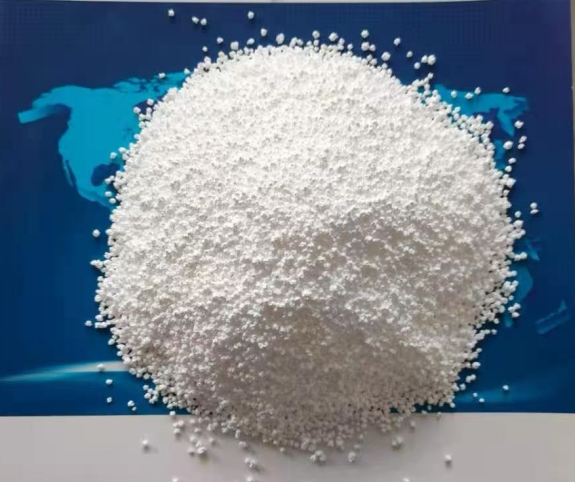
A 77% prill spec sheet looks straightforward until you compare two suppliers side by side. The headline number is CaCl2 content, but the remaining 23% usually includes water of crystallization plus a mix of alkali metal chlorides. Check the sodium and potassium chloride limit carefully—if it runs above 3% combined, you are paying for material that will underperform in de-icing and dust control because less active calcium chloride reaches the road or soil.
Moisture and particle size distribution control how the prills behave before they ever touch ice or gravel. Free moisture above 1–2% leads to clumped bags, jammed augers, and inconsistent spreader output. For most winter maintenance and road stabilization work, the bulk of prills should fall between 1 mm and 4 mm. Too many fines create airborne dust during handling, while oversized particles dissolve too slowly and leave visible residue on pavement.
Two more lines deserve attention: water-insoluble content and magnesium chloride. Insolubles over 0.2–0.3% will plug spray nozzles and settle out in brine tanks, adding maintenance time. Magnesium chloride is even more hygroscopic than calcium chloride, so a few percent can turn dry prills into a sticky, caked mess in humid storage. If the material will sit near concrete or steel, also note the pH and any corrosion inhibitor statement—low pH accelerates chloride attack far beyond what the calcium chloride alone would cause.
Where Industrial Buyers Get Burned (and How to Avoid Those Pitfalls)
Many industrial buyers walk into supplier negotiations expecting clear specifications and reliable lead times, only to discover hidden tooling charges, surprise freight costs, or material substitutions that were never discussed upfront. The first burn often happens when a quote looks too good to be true—perhaps because it omits critical testing, certification, or compliance requirements that later balloon the total cost. Another common trap is relying on a single source for a mission-critical component. When that supplier hits a production snag, the buyer absorbs the downtime. To avoid these pitfalls, smart buyers now demand a detailed cost breakdown before signing anything, and they routinely qualify at least two approved vendors for every high-risk part.
Beyond pricing and sole sourcing, industrial procurement teams get burned by vague quality clauses. A drawing that says “standard tolerance” or “commercial grade” opens the door for parts that technically meet the letter of the contract but fail in the field. Then there’s the issue of payment terms—some buyers prepay large deposits to overseas factories, only to find their orders deprioritized when the factory lands a bigger client. The fix is to write engineering specifications with measurable limits, include third-party inspection rights, and tie payment milestones to verified progress, not just promises.
Finally, many buyers overlook the cost of switching suppliers until it’s too late. They chase a lower unit price without calculating the revalidation, retooling, and regulatory paperwork that a new vendor requires. That hidden switching cost can wipe out years of savings. A better approach is to run a total cost of ownership analysis that includes freight, inventory carrying costs, scrap rates, and field failure risk. By mapping out every step where money can leak, industrial buyers can turn procurement from a game of guesswork into a disciplined, defensible process.
Comparing Manufacturing Processes: Flake vs. Prill vs. Pellet Performance
Manufacturers often overlook how particle geometry dictates handling and dissolution, yet the distinction between flakes, prills, and pellets can reshape downstream performance. Flakes, produced through chilled roller compaction, offer a flat, irregular surface that maximizes surface area but tends to interlock during storage, creating bridging issues in hoppers. Prills, formed by spraying molten material into a cooling tower, yield smooth, spherical granules with excellent flowability but slower dissolution due to reduced porosity. Pellets, typically extruded and spheronized, strike a balance: their uniform size and controlled density allow predictable metering, though they require more energy-intensive processing.
Field data from fertilizer and detergent lines shows that prills outperform flakes in pneumatic conveying systems because their low friction coefficient prevents equipment wear, whereas flakes often clog rotary valves. Conversely, when rapid solubility matters—such as in water treatment chemicals—flakes dissolve up to 40% faster than prills of equivalent mass. Pellets occupy the middle ground, often chosen for controlled-release formulations where surface erosion must proceed at a steady rate. The real challenge lies not in absolute superiority, but in matching particle architecture to the constraints of storage, transport, and end-use conditions.
A practical decision framework starts with bulk density and angle of repose: flakes typically show wider variability, demanding vibration-assisted discharge, while prills flow under gravity alone. Energy audits further reveal that pelletizing consumes roughly twice the power of prilling per ton, yet avoids the dust generation common with flake systems. Smart operators therefore run mixed lines—using prills for high-volume commodity products and reserving flakes or pellets for niche applications where dissolution kinetics or structural integrity justify the added cost.
Logistics and Storage Factors That Affect Product Integrity
A product’s journey from warehouse to end user often decides whether it arrives intact or falls apart before the first use. Temperature swings, rough handling, and stacking pressure aren’t just operational nuisances—they directly chip away at structural strength, seal reliability, and even chemical stability. For example, corrugated packaging that sits too long in humid conditions loses its crush resistance, while sensitive adhesives or coatings can delaminate if pallets are left in direct sun during transit. These are not edge cases; they are everyday realities that quietly undermine customer trust.
Storage layout and warehouse practices shape integrity just as much as the shipment itself. Pallets double-stacked beyond rated limits transfer uneven loads, warping lids or cracking brittle components. Even a well-designed product can fail if it’s stored near racking uprights that vibrate constantly or if forklift operators routinely clip the lower tiers. The real issue is rarely a single impact—it’s the accumulation of small stressors over weeks or months that compound into visible damage. Smart operations treat storage not as passive warehousing but as an active part of quality control.
What makes logistics-driven integrity issues so tricky is that they often mimic manufacturing defects. A hairline fracture from repeated vibration looks identical to a casting flaw. A corroded battery contact from condensation appears as a plating failure. Without recognizing the supply chain as a variable, teams waste time chasing root causes in the wrong place. The most resilient brands map each storage and transport step against the product’s specific sensitivities—whether that means isolating hygroscopic materials, enforcing maximum stack heights, or auditing trailer conditions before loading. That level of granularity separates products that consistently arrive pristine from those that merely leave the factory that way.
Questions to Put to Any Manufacturer Before You Commit
Before you sign anything, dig into their actual production capacity. Ask how many units they can realistically turn around in a month, not what their website claims. Get specifics on lead times for repeat orders, and what happens when a machine breaks down or a key material runs late. A good manufacturer will give you honest numbers and a backup plan, not a vague promise.
Find out who you'll be talking to after the contract is signed. Will you have a dedicated account manager, or will your emails disappear into a shared inbox? Request a clear process for approvals, sample revisions, and order changes. If they can't walk you through that on a call, that's a red flag. Ask how disputes or defects are handled, and whether they'll cover the cost of a bad batch or expect you to absorb it.
Finally, ask for references from clients who've placed similar orders in the last six months. Then actually call them. Ask those references about delays, hidden fees, and how the manufacturer reacted when something went wrong. You'll learn more from one honest conversation than from a dozen polished brochures.
FAQ
Ask for a full certificate of analysis covering CaCl2 assay, magnesium and sodium chloride levels, sulfate content, and water-insoluble residue. A reliable prill product will show at least 77% CaCl2 on a dry basis and a consistent particle size range, often 0.5 to 2.5 mm, so it feeds smoothly in hoppers.
Spherical prills resist bridging and flow better from silos and spreaders than flake material. Larger prills release moisture more slowly, which extends dust suppression on haul roads; smaller prills dissolve faster for ice melting but are more prone to caking if stored in damp conditions.
Typical uses include deicing parking lots and highways, controlling dust on unpaved surfaces, accelerating concrete set time in cold weather, weighting tractor tires, and brine production for oilfield or water treatment operations.
Buy in moisture-resistant bags or supersacks with inner liners, and store pallets indoors or under a tarp away from ground moisture. Keep bags sealed until use because calcium chloride aggressively absorbs humidity and will form a hard crust if exposed to air.
Request batch-level test data from the past six months, not just a one-time sample. Ask about production capacity, lead times during winter peak season, and whether the manufacturer uses continuous drying and screening to remove fines before packaging.
At 77% CaCl2, prills contain enough active ingredient for serious deicing and dust control but still include some moisture and minor salts that aid handling and reduce dust during transfer. Lower grades force you to apply more product, while higher grades are usually custom blends that cost significantly more per ton.
Calcium chloride demand spikes before winter storms, so prices and transit times rise from October through February in northern markets. Secure annual contracts with scheduled releases in early fall, and verify your supplier has multiple distribution points to avoid shipping delays from a single plant.
Watch for excessive magnesium chloride, sodium chloride, and sulfate because they reduce effective calcium chloride content and can corrode equipment. Ask the supplier to certify heavy metals such as lead and arsenic are below typical industrial thresholds, especially if the prills may contact groundwater.
Conclusion
Heavy-duty de-icing, dust control, and industrial processing demand a calcium chloride product that does not fall apart under real workloads. The 77% prill grade stands out because its purity hits a sweet spot: enough active CaCl₂ to melt ice and bind fines without the extra cost and handling headaches of higher assay material, yet strong enough to outperform the cheaper 74% or lower flakes that often carry excessive insoluble residue and slow dissolution. Reading a spec sheet properly is where many buyers stumble. The numbers that actually matter include total calcium chloride content, magnesium and alkali chloride levels, sulfate content, pH, and particle size distribution. A tight prill size range means fewer fines, less dust, and predictable spreading or blending. Watch for vague language like “typical analysis” without batch-level data or third-party verification. Plenty of buyers get burned by assuming all 77% prills are equal; hidden moisture, inconsistent sizing, or off-spec impurity spikes can wreck a process. Ask for a certificate of analysis from the most recent production run, not a marketing brochure.
Manufacturing route changes how the product behaves on site. Flake calcium chloride has high surface area but breaks down into dust and tends to clump badly in humid air. Pellets may look uniform but often dissolve slower because of their compacted density. Prills from a controlled granulation or prilling tower offer a better balance: free-flowing, low-dust, and quick to dissolve when sized correctly. Logistics and storage decide whether that quality survives until use. Prills are hygroscopic; if bags or supersacks are not sealed with an inner liner and stored off the floor in a dry area, caking and moisture uptake can ruin the 77% concentration. Ask any manufacturer directly about their packaging specifications, palletization, and recommended shelf life under typical warehouse humidity. More importantly, request a transparent explanation of their production consistency—how often they test, what happens with off-spec batches, and whether they can provide references from buyers running similar applications. A supplier who hesitates on these questions or cannot show real batch data is not a reliable partner for industrial volume.
Contact Us
Contact Person: Tom Cui
Email: [email protected]
Tel/WhatsApp: +8618663670626
Website: https://www.jinjigoldenchem.com